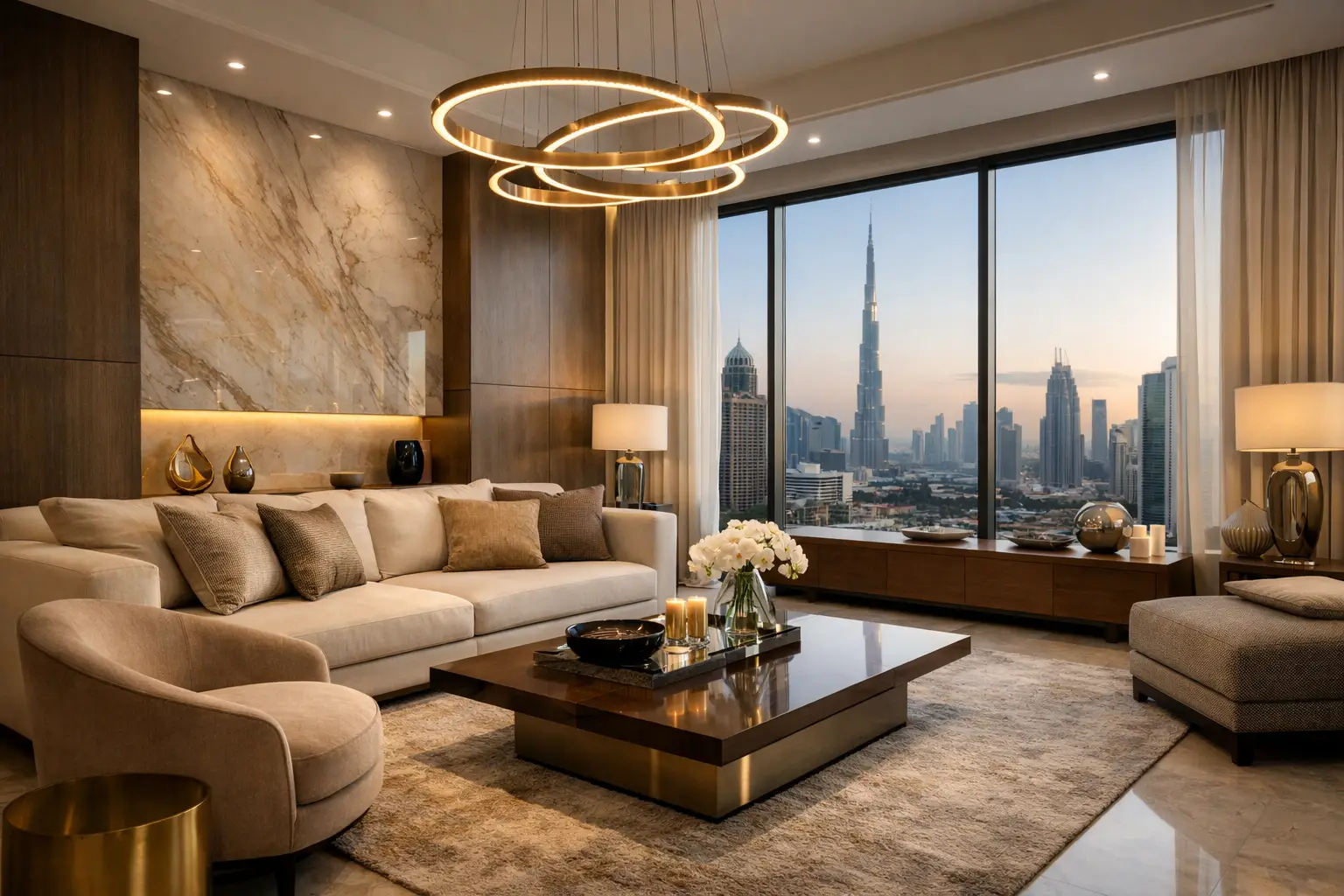
A Dubai living room often has to do more than one job well. It may welcome guests, frame a skyline or garden view, accommodate family evenings, and set the visual standard for the rest of the home. Thoughtful living room interior design Dubai brings those demands into balance, creating a room that feels composed at first glance and works effortlessly every day.
The difference is rarely one dramatic furniture piece. It is the coordination of layout, lighting, materials, custom joinery, and finishing details. When these elements are planned as one complete fit-out, the result feels intentional rather than assembled over time.
Start With How the Room Will Be Used
A successful living room begins with practical questions. Is the space primarily for relaxed family use, formal entertaining, or both? Does it need a reading corner, a discreet work surface, a media wall, or extra storage for children’s items? The answers determine far more than the sofa style.
In larger villas, a living room can support distinct zones without feeling divided. A conversation area may face the view, while a secondary seating group creates a quieter place for reading or coffee. In an apartment, the priority is often clear circulation and furniture scaled to the room. Oversized seating may look impressive in a showroom but can make a compact living area difficult to move through.
The best layouts preserve breathing room around key pieces. They establish a natural route from the entry to the seating area and keep pathways clear of coffee tables, floor lamps, and open cabinet doors. This is where professional space planning adds real value: proportions are resolved before fabrication or purchasing decisions become expensive to change.
Living Room Interior Design in Dubai Needs Material Discipline
Dubai homes place particular demands on finishes. Strong daylight, air conditioning, dust, regular entertaining, and the expectations of a polished home all influence what will perform well over time. A delicate finish may suit a low-traffic formal lounge, while a busy family room needs surfaces that are easier to maintain and less likely to show daily wear.
Upholstery should be selected for both texture and use. Performance fabrics, quality leathers, and tightly woven textiles can offer a refined appearance while standing up to frequent use. Pale shades create an airy, elegant effect, but they benefit from fabrics designed for practical cleaning. Darker tones can feel grounded and sophisticated, though they require sufficient lighting so the room does not become visually heavy.
For cabinetry and wall treatments, durable boards, carefully specified veneers, lacquered finishes, stone, glass, and metal accents each have a place. The right choice depends on the room’s light exposure, desired maintenance level, and overall design direction. A material palette should not be chosen solely from small samples. Scale, sheen, undertone, and how each finish meets another surface matter just as much.
Build a Strong Visual Anchor
Every well-designed living room needs an anchor that gives the eye a place to rest. This might be a custom TV wall, fireplace surround, feature stone panel, panoramic window, or a tailored composition of art and joinery. Without one, even high-quality furniture can appear scattered.
A media wall is often the most hardworking option. It can conceal cables, organize devices, incorporate display niches, and provide closed storage for the items that do not need to remain visible. Done well, it is more than a television backdrop. It becomes an architectural feature that brings order to the room.
The key is restraint. Excessive open shelving, multiple competing finishes, or decorative lighting in every niche can make a wall feel busy. A cleaner composition with a defined focal point, balanced storage, and precise proportions generally gives a more enduring result. Custom joinery makes this possible because dimensions, materials, and details are developed specifically for the room rather than forced around a standard cabinet size.
Layer Lighting Instead of Relying on One Fixture
A central chandelier may create presence, especially in a formal reception space, but it should not carry the whole room. Living rooms need layers of light to shift comfortably from daytime gatherings to quieter evenings.
Ambient lighting establishes general brightness. It can come from recessed ceiling lights, cove lighting, or a carefully selected decorative fixture. Task lighting supports activities such as reading and can be added through floor lamps or table lamps. Accent lighting brings depth to artwork, textured walls, display shelves, and architectural details.
Dimming is essential. It allows a bright, open room to become warmer and more intimate after sunset, while giving homeowners the flexibility to adapt the setting for guests, films, or everyday use. Lighting temperatures should also be coordinated. Mixing harsh cool light with warm decorative lighting can undermine an otherwise refined interior. A consistent warm-white approach usually flatters natural materials, textiles, and skin tones.
Let Custom Joinery Solve the Clutter Problem
Luxury is not only about what is displayed. It is also about what has been thoughtfully put away. Living rooms quickly lose their calm when remotes, chargers, games, throws, paperwork, and devices have no designated place.
Custom cabinetry can solve this without making the room feel like a storage area. Low consoles can preserve a horizontal, expansive feel. Full-height panels can integrate hidden cupboards into a feature wall. Window benches may create extra seating with concealed storage below. Even a slim side cabinet can be designed to hold practical items while maintaining the visual language of the room.
The internal organization is as important as the exterior finish. Cable access, ventilation for equipment, adjustable shelves, soft-close hardware, and practical drawer depths should all be considered during planning. These details are rarely visible in a final photograph, yet they shape how satisfying the room is to live with.
Choose a Style That Will Still Feel Right Later
Dubai interiors can range from warm contemporary and modern classic to minimalist, Mediterranean-inspired, or richly layered luxury. There is no single correct style. The stronger question is whether the room reflects the homeowner’s taste and has enough design clarity to remain appealing after passing trends change.
A warm contemporary scheme is often a versatile choice. It pairs clean lines with timber tones, textured fabrics, soft neutral colors, and restrained metal details. It feels current without depending on novelty. Modern classic interiors can bring more formality through panel molding, symmetry, statement lighting, and elegant stone, but they require careful proportion to avoid feeling overworked.
Minimalism can be equally successful when it is not confused with emptiness. A restrained room still needs texture, comfort, and functional storage. The trade-off is that fewer elements leave less room for poor execution. In a pared-back space, alignment, shadow gaps, material joins, and finishing quality become highly visible.
Treat Execution as Part of the Design
A living room concept is only as strong as its installation. Misaligned joinery, uneven paintwork, poorly placed electrical points, or visible cable routes can dilute the effect of even the best materials. That is why design, fabrication, and site execution should be coordinated from the beginning.
Before work starts, confirm the furniture plan, electrical layout, lighting positions, curtain or blind requirements, ceiling details, and joinery drawings. This reduces late changes and helps each trade work from the same direction. Clear communication also protects the project timeline, especially when custom elements require fabrication before installation.
At Al Khalaq, this integrated approach brings planning, material selection, bespoke joinery, installation, and final finishing under one accountable process. It allows the living room to be built as a complete experience, with every line and surface considered in relation to the next.
The most rewarding living rooms do not feel designed only for a reveal. They feel right on an ordinary evening: comfortable, organized, beautifully lit, and ready for the people who use them. Begin with how you want to live in the room, then let craftsmanship give that vision a lasting form.
Leave a Reply